Insight ·
From noise to trust: Why communication must become a governance function in the AI era

A cloned voice note could make employees believe their chief executive has announced retrenchments. A fabricated video could put words into a mayor’s mouth. An authoritative-looking policy document could cite non-existent academic research.
These examples expose a growing institutional vulnerability: information can look credible long before anyone establishes whether it is true.
South Africa’s withdrawn draft national artificial intelligence policy brought that problem into public view. In April, Communications and Digital Technologies Minister Solly Malatsi withdrew the document after an internal process confirmed that its reference list contained fictitious sources.
“This failure is not a mere technical issue but has compromised the integrity and credibility of the draft policy,” he said.
The implications extend beyond one government document. A failure in research, verification or approval can undermine confidence in an institution’s competence and judgement. Once that happens, the communications team is left explaining a problem it should have helped the organisation prevent.
Communication therefore needs a stronger role in governance: how institutions make decisions, assess risks, establish responsibility and account for their actions.
A global information risk with local consequences
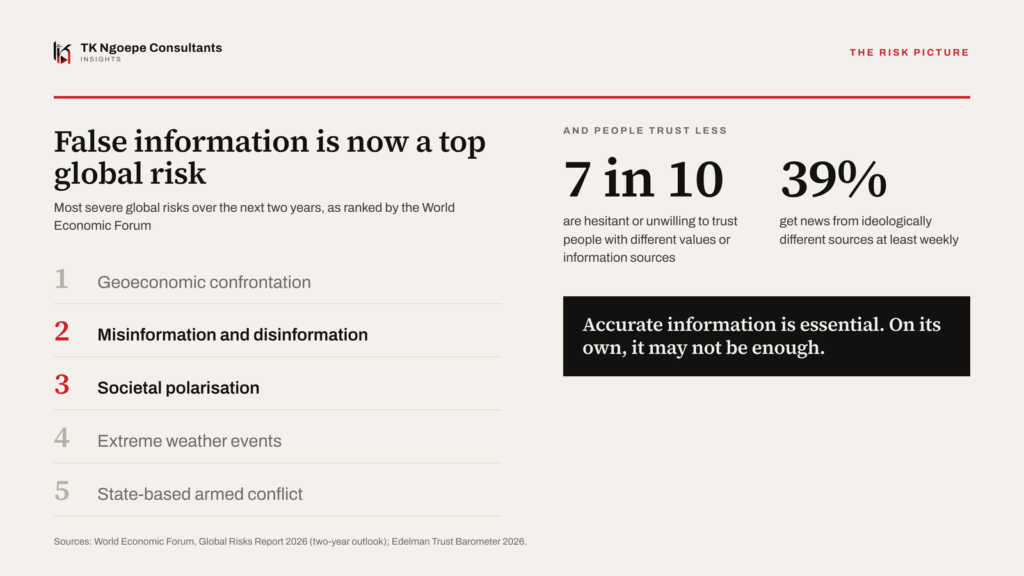
The World Economic Forum’s Global Risks Report 2026 ranks misinformation and disinformation second in its two-year risk outlook, with societal polarisation third. The findings reflect expert perceptions of risk, not predictions of specific events, but they show how central information integrity is to global concerns.
Public attitudes make the challenge harder. Edelman’s 2026 Trust Barometer found that seven in 10 respondents were hesitant or unwilling to trust people with different values, backgrounds, approaches to social issues or information sources. Only 39% reported getting news from ideologically different sources at least weekly.

For communicators, this means that publishing accurate information is essential, but may not be sufficient. Audiences also assess who is speaking, whether the institution has kept previous promises and whether its explanation matches their experience.
A public statement about improved service delivery will struggle to persuade people still facing unanswered complaints. An employer’s reassurance may carry little weight if workers first learn about important decisions through rumours.
Credibility rests on the relationship between institutional conduct and institutional communication.
South Africa’s AI-policy setback reveals a verification gap
The withdrawn policy illustrates how easily a document’s apparent authority can conceal weaknesses in its evidence.
In a September interview with Daily Maverick, Malatsi acknowledged that the bibliography had not been interrogated. He said the goal was to have a revised draft ready for Cabinet by the end of the financial year in March 2027. That is a target for presenting a draft, rather than confirmation that a final policy will be operating by then.
The lesson for institutions is practical. Human oversight must involve more than reviewing grammar, tone and presentation.
References must exist and support the claims attributed to them. Quotations must be checked against their source. Figures must retain their context. Policy statements must distinguish proposals, approved decisions and measures already in force.
AI can assist with drafting, summarising, translation and analysis. It cannot take responsibility for an organisation’s publication decisions. A named person must remain accountable for checking and approving what is released.
Disclosure matters too, particularly where synthetic audio or video could mislead an audience about who spoke or what occurred. But disclosure does not make inaccurate content acceptable. Labelling and verification serve different purposes, and institutions need both.
Countering falsehoods must not become controlling criticism
Government has also announced plans to strengthen its response to misinformation.
In May, the Government Communication and Information System outlined proposals for disclosure of AI-generated content on digital platforms, restrictions on false and misleading broadcasts, and a public fact-checking capability. It also announced work on a guide for government communicators. These were proposed measures and planned initiatives, rather than proof that a comprehensive new regulatory system was already in operation.
Any such response needs safeguards.
Institutions must distinguish demonstrably false information from criticism, disagreement, satire and reporting that exposes genuine failures. Calling an uncomfortable question “misinformation” does not answer it.
Southern Africa offers a warning about the risks of overreach. In July, Amnesty International criticised the arrest of Zambian journalist MacPherson Mukuka over allegations involving the recording and publication of a private conversation. The organisation warned that the application of cybercrime legislation could have a chilling effect on investigative journalism.
Protecting information integrity requires transparent methods, accessible evidence and a willingness to correct mistakes. It also requires independent journalism and space for public scrutiny.
An institution cannot build durable trust by demanding that only its own account be believed.
Africa’s digital future depends on being understood
The continental debate is moving towards implementation.
The African Union has announced a communication and ICT meeting in Libreville later this month to review digital-policy progress, including the Continental AI Strategy, data governance, cybersecurity and digital inclusion. Its agenda addresses barriers affecting women, young people, people with disabilities, rural communities and other underserved groups.
These priorities have direct implications for communication.
A technically accurate announcement may still fail if its intended audience cannot understand it, access it or ask questions about it. A lengthy English-language document published online is not necessarily an effective explanation for a multilingual community with uneven connectivity.
Institutions should design communication around the people affected. That may require local-language material, accessible formats, community radio, frontline staff briefings and face-to-face engagement alongside digital channels.
Listening is equally important. Questions, complaints and repeated misunderstandings can reveal weaknesses in a policy or service. Communication should bring that evidence into decision-making, rather than simply distribute the institution’s preferred message.
Regional responses show why coordination matters
There are useful examples of technology supporting, rather than replacing, human judgement.
In February, UNDP and Panos Institute Southern Africa relaunched iVerify Zambia 2.0. UNDP described the platform as combining AI-enabled monitoring and early warning with human verification, coordinated responses and public media literacy.
South Africa’s Electoral Commission announced a partnership on 20 October with Google, Meta, Microsoft, TikTok and Moxii Africa to counter election disinformation. The initiative accompanies a disinformation code gazetted in September, moving the response beyond the earlier draft rules.
“A technically flawless election can still lose public trust if citizens are overwhelmed by disinformation,” chief electoral officer Sy Mamabolo said.
For institutions outside elections, the same operational lesson applies. Monitoring a false claim is only the beginning. Someone must verify it, assess its potential harm, authorise a response and ensure that accurate information reaches the affected audience.
What communication as governance looks like
Communication needs access to leadership before a decision becomes an announcement.
Its role includes testing whether a promise is supported by operational capacity, identifying stakeholders who may be overlooked and anticipating questions that the institution must be ready to answer.
This requires cooperation between communications, operations, human resources, legal advisers, technology teams and executive leadership. No communications department can reliably explain a service disruption if it cannot obtain verified operational information.
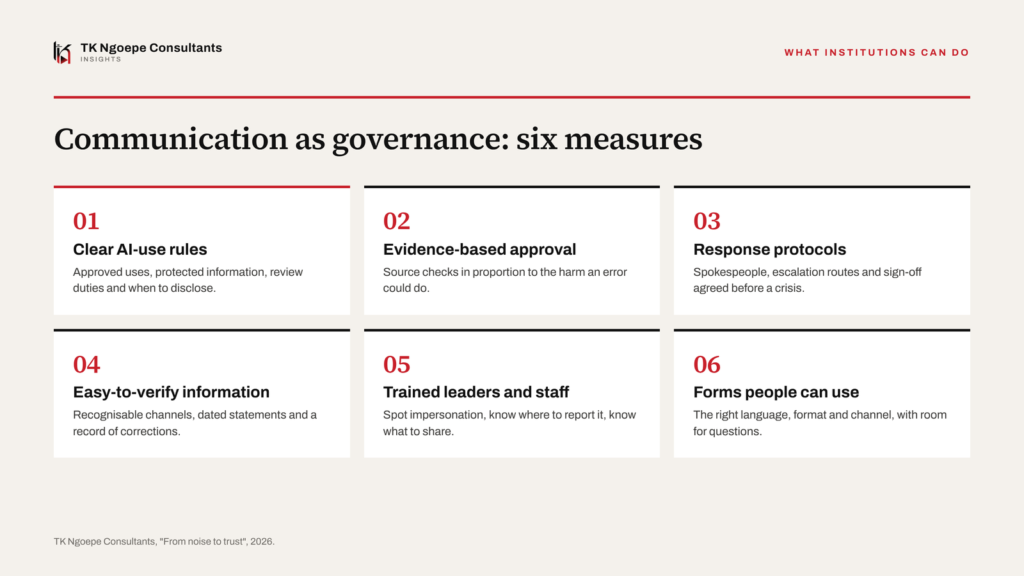
Institutions can strengthen that cooperation through six practical measures:
- Establish clear AI-use rules. Define approved uses, protected information, review responsibilities and circumstances requiring disclosure.
- Create an evidence-based approval process. Require source checks proportionate to the potential harm of an error, with stronger review for sensitive announcements.
- Prepare response protocols. Identify spokespeople, escalation routes and approval responsibilities before a crisis. Holding statements should explain what is known, what remains uncertain and when an update will follow.
- Make official information easy to verify. Maintain recognisable channels, dated statements and a clear record of corrections.
- Train leaders and frontline staff. Employees need to recognise suspected impersonation, know where to report it and understand which information they may share.
- Communicate in forms people can use. Match language, format and channel to audience needs, with opportunities for questions and feedback.
Listening to concerns circulating through messaging apps should rely on voluntary reporting and lawful engagement. Institutions should not assume they can or should monitor private conversations.
Preparation must also support speed. Approval processes that take days to release basic verified information can leave room for speculation. The answer is to agree responsibilities and escalation thresholds in advance.
Measure understanding and trust alongside reach
Impressions, coverage and shares reveal how far a message travelled. They do not establish whether it was understood or believed.
Institutions should also assess whether stakeholders can explain a policy accurately, whether recurring misconceptions are declining, whether employees know where to verify information and whether complaints receive useful answers.
Surveys, interviews and service feedback can help. Changes in behaviour should be interpreted carefully, because communication is rarely the only influence.
At TK Ngoepe Consultants, the strategic priority is to connect communication with the decisions and conduct that make an institution credible. A polished campaign cannot compensate indefinitely for inaccurate information, inaccessible leadership or promises that remain unfulfilled.
AI will continue to expand the speed and scale of content production. Leaders must ensure that information carrying their institution’s name can be checked, explained and corrected.
The organisations best prepared for the next false claim will be those that have already given people sound reasons to trust them.